






 |
|
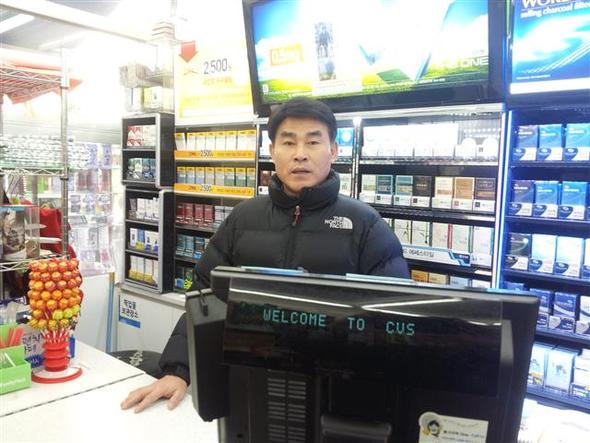
Kim Young-hyun is interviewed at his Choco Mart store in Seoul��셲 Seongbuk districton Feb. 15. ���
|
Merchants seek a fairer business climate after suffering under the thumb of chaebols
By Kim Su-heon, staff reporter
“Above all, we are working to stop unfair franchise business practices by chaebol-owned parent companies. In the long run, we‘re trying to create a convenience store cooperative with its own computerized distribution network”.
Being ready for launch at the end of the month, South Korea’s first convenience store owners’ cooperative, ‘National Convenience Store Business Cooperative (NCSBC)’ director Kim Young-hyun told the Hankyoreh on Feb. 15, “Instead of the current system where parent companies squeeze the franchise branch owners for profit, we will create a business model that enables shared benefits for convenience store owners as members of a cooperative. That is the road to economic democratization”.
The NCSBC consists of about 30 owners of former CU convenience stores. They had an inaugural assembly last month and submitted documentation to Seoul City Government for the cooperative’s official establishment. Each member paid a 10 million won (US$9275) member investment fee, and the cooperative will begin full operation at the end of the month after formal registration.
Although Kim is currently managing a convenience store in the Seokgwan neighborhood of Seoul’s Seongbuk District, he owned a Family Mart (CU’s former name) convenience store until last September. He felt the full effect of unfair business practice by the company while managing a chaebol-owned convenience store. “The franchise commission fee was 35% of monthly profits, which was excessive. And the store had to be open 24 hours even though it lost money at night. Although I wanted to quit it wasn’t possible because the penalty for breaking the contract would have been too much. There are many other unfair contract terms. With over twenty thousand convenience stores, the parent company is making huge profits, but the majority of franchise store owners barely earn enough to get by”.
Deep debt led Kim to quit managing his franchise convenience store. The parent company’s arbitrary decision to change the brand name from Family Mart to CU without the consent of the branch owners also affected Kim’s decision to quit.
The parent company’s demand of breach of contract compensation and remaining value of interior expenses was over 50 million won (US$46,369). As a result, after ending the contract and deciding to take the compensation claim to court, he changed the store sign to ‘Choco Mart’.
Kim also created a blog to inform others about the tyranny of the parent company. After the Cooperative Basic Act was passed last December, Kim thought a cooperative could unite the branch owners to more effectively counter the parent company. He immediately shared his opposing thoughts on the parent company with the other CU storeowners to form a mutual understanding and establish the cooperative. Bang Kyung-su, who knew about cooperatives, helped to ease the process of establishment. Bang was made chairman at the inaugural assembly for the cooperative.
Kim emphasized, “When members of the cooperative participate in the decision-making process, the practice becomes firm and a large ripple effect will take place in the franchise business world”. However, it remains to be seen if a cooperative with about only 30 members can have any influence in an industry dominated by chaebol.
Kim was confident in saying, “Although it may not be easy, by dividing our objectives into short and long term plans and by approaching the problem strategically with legislative and financial support from political circles and the government, we can manage anything”.
The cooperative plans to help franchise branch owners negotiate with their parent companies on equal grounds and improve the poisonous terms in the contracts between the parent company and branch owners. It is another strategy of the cooperative to apply business mediation services for the Small and Medium Business Administration (SMBA). Its goal is to prevent the expansion of chaebol-owned stores, such as CU, 7-11 and GS25. Kim expects that with the attention of the public and the SMBA’s approval and intervention, the cooperative will expand.
“Every month, about 300 contracts expire of stores who have contracts with chaebol-owned parent companies. It is important for those storeowners to join the cooperative. When membership reaches 1000, we will be on the right track”.
The ultimate goal is to create a chaebol company-like system with its own computerized distribution network, where franchise commission fees and 24-hour operation are not mandatory. With these terms, members of the cooperative should be able to compete with chaebol franchises in a fairer business climate.
“By increasing membership to over 5,000, accumulating capital of over 5 billion won (US$4.6 million), and receiving financial support from the local and national government, it will be possible. We will work to achieve our goals within five years”.
Translated by Kim Kyung-min, Hankyoreh English intern
Please direct questions or comments to [english@hani.co.kr]